Careers


Build the infrastructure that makes the next century of space possible.

Careers


Build the infrastructure that makes the next century of space possible.

About Symphony Space


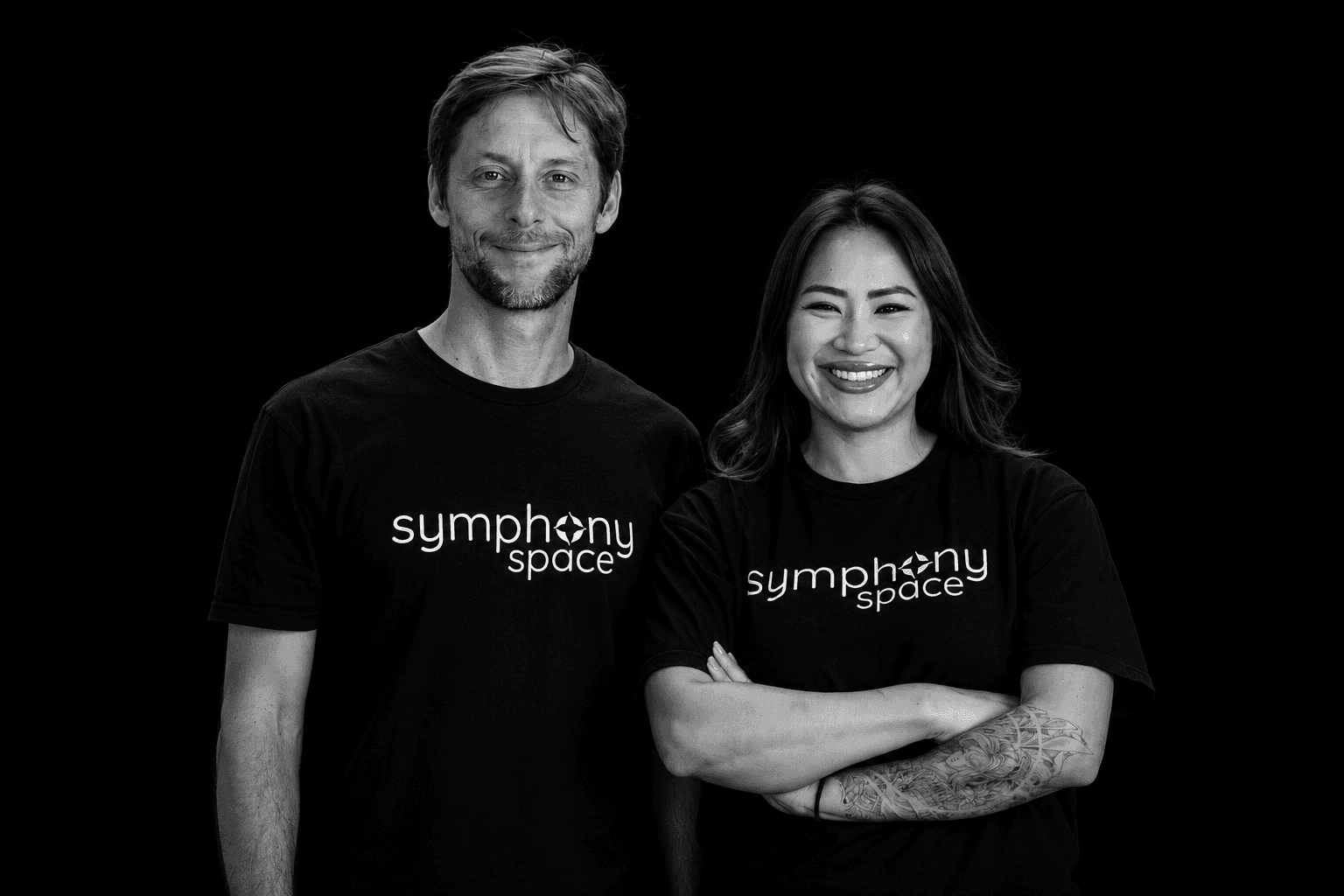
Symphony Space is an early-stage U.S. space company building modular, autonomous space stations. We are headquartered in Arlington, Virginia and are assembling a small, exceptional engineering team from the ground up.


If you are excited about rethinking how spacecraft are designed, deployed, and operated — and you want to help build something new rather than maintain something that already exists — we would love to hear from you.


Working Here


These are founding-team roles. You will be one of the first engineers at the company, working directly with the CTO and Chief Engineer. You will own a whole domain rather than a narrow task list, set the standards others build on, and grow specialist depth as the program matures.


We are currently hiring across four roles:


•    Chief Engineer

•    Systems Engineer — Electrical & Power

•    Systems Engineer — Mechanical & Thermal

•    Systems Engineer — Software & GNC


Chief Engineer

Technical lead across the whole spacecraft · Reports to the CTO

As Chief Engineer you are the single technical authority for the platform, from concept through validation. You own the overall architecture, keep every subsystem talking to every other subsystem, and build and lead the engineering team as we scale.

What you'll do

•    Own the overall platform architecture and act as the authority on how subsystems and partners connect (interface control).

•    Lead the design, development, and verification plan, and keep requirements traceable from top to bottom.

•    Chair technical reviews and drive the team to clear decisions.

•    Set the simulation and modeling strategy across mission analysis, power, thermal, structures, RF, and flight software.

•    Lead the program management of our most critical, IP-heavy subsystems, including schedule, risk, and subcontractors.

•    Build and lead the engineering organization: plan headcount, recruit, onboard, and mentor engineers as the team grows.

•    Establish engineering standards, configuration management, and documentation practices.

•    Support government proposals and represent Symphony Space at technical reviews and with customers.

What we're looking for

•    M.S. or Ph.D. in aerospace, systems, electrical, or a related engineering field.

•    15+ years in space systems engineering, with clear technical leadership on satellite or spacecraft programs.

•    Has taken at least one spacecraft program from concept through launch as systems engineer or technical lead.

•    Deep experience with interface control, requirements, and verification and validation planning.

•    Strong program management skills across schedule, risk, and resources.

•    Experience building and leading engineering teams across multiple disciplines.

•    Experience with U.S. government space programs (Department of War or NASA) and the proposal process.

•    U.S. citizen or legal permanent resident.

Nice to have:

•    Prior Chief or Deputy Chief Engineer experience on a satellite program.

•    Experience with modular spacecraft, hosted payloads, or novel interface concepts.

•    Familiarity with wireless power or data transfer systems.

•    Active U.S. security clearance or eligibility.

You thrive in ambiguity, can hold the big picture and dive into the details in the same day, and know how to build consensus among experts. You want to build something.


Systems Engineer — Electrical & Power

Electrical power, RF & communications · Reports to the CTO and Chief Engineer

You are the technical lead for how the spacecraft makes and moves power and how it talks — to the ground and between its own modules. As the team grows, you will lead the engineers working in these areas.

What you'll do

•    Own the power budget across every mission phase and design the core power system: solar arrays, batteries, and power distribution.

•    Decide how solar panels are accommodated, balancing power generation against pointing needs.

•    Lead the design of the power transfer subsystem.

•    Select and qualify power components and define their interfaces and test plans.

•    Design the ground communications link (S-band and/or UHF) and run the link budgets for normal and contingency operations.

•    Lead the design of the wireless data link between the bus and payload modules.

•    Define the security approach for the communications chain.

•    Design the overall electrical architecture: power distribution, harness routing, and EMC/EMI management.

•    Coordinate with the ground segment on antennas, frequencies, and regulatory licensing (FCC/ITU).

•    Support assembly and test for the power and RF systems.

What we're looking for

•    B.S. or M.S. in electrical or aerospace engineering.

•    7+ years spanning both spacecraft power systems and RF/communications.

•    Experience sizing solar arrays and batteries for LEO spacecraft and building power budgets.

•    Experience performing link budgets for space-to-ground communications.

•    Familiarity with space communication standards (e.g. CCSDS) and EMC/EMI design practices.

•    U.S. citizen or legal permanent resident.

Nice to have:

•    Experience with wireless power transfer (inductive or resonant coupling).

•    Experience with short-range or intra-spacecraft RF links.

•    Knowledge of cryptographic/COMSEC systems for space.

•    Familiarity with FCC/ITU frequency coordination and spacecraft-level electrical and RF testing.

You are comfortable moving between a power spreadsheet and an RF link budget in the same week, and you understand that on a small team these two domains are deeply intertwined.


Systems Engineer — Mechanical & Thermal

Structures, mechanisms & thermal control · Reports to the CTO and Chief Engineer

You own the physical spacecraft — the part that has to survive launch and operate in space. You lead the structural and thermal design of the bus and payload pods, keep the master CAD model, and take the design through its qualification test campaign.

What you'll do

•    Own and maintain the master CAD model and control all mechanical interfaces.

•    Define the structural design of the core bus: primary structure, panels, interface ring, launch adapter, and deployment mechanisms.

•    Lead the mechanical design of the payload pods, including how they attach and release.

•    Own the mass budget: run mass trades, hold allocations, and track margin against the launch vehicle's capacity.

•    Run structural analysis (FEA) for launch loads, vibration, and shock, and iterate the design to meet margins.

•    Design the thermal control system — insulation, coatings, radiators, and heaters — for the bus and payload pods.

•    Build and maintain the thermal model and run hot- and cold-case analyses across all mission phases.

•    Select materials and coatings that hold up to the space environment.

•    Plan and run the thermal-vacuum (TVAC) test campaign and support the wider assembly, integration, and test effort.

What we're looking for

•    B.S. or M.S. in aerospace, mechanical, or a related engineering field.

•    7+ years in spacecraft mechanical or thermal engineering, including at least one satellite program taken from design review through launch.

•    Hands-on experience with spacecraft structural analysis (launch loads, modal, vibration, shock).

•    Experience building and running spacecraft thermal models and working with orbital heat environments.

•    Strong 3D CAD skills and experience managing complex assemblies under configuration control.

•    Experience owning a mass budget and tracking margin against launch-vehicle limits.

•    Familiarity with spacecraft materials, coatings, and insulation.

•    U.S. citizen or legal permanent resident.

Nice to have:

•    Experience planning and running TVAC test campaigns and correlating models to test data.

•    Knowledge of modular or deployable structures, hinges, and separation/release mechanisms.

•    Familiarity with ECSS or equivalent NASA/MIL standards, and experience in an ITAR-controlled environment.

You are equally at home sketching a structure in CAD and interrogating a thermal model to find out why a battery is running hot. You think in margins and know that a beautiful structure that fails TVAC is not a beautiful structure.


Systems Engineer — Software & GNC

Flight software, on-board computing & guidance, navigation and control · Reports to the CTO and Chief Engineer

You lead the software that flies the spacecraft and the guidance, navigation, and control that keeps it pointed and on orbit. This is a broad role for someone who can write flight software in the morning and run a trajectory simulation in the afternoon.

What you'll do

•    Design and own the flight software architecture for the on-board computer.

•    Define the software that lets the bus and payload modules talk to each other.

•    Implement command and telemetry handling, fault management, and relevant space standards.

•    Build software- and hardware-in-the-loop environments to test the flight software.

•    Set up the software development process: version control, CI/CD, coding standards, and documentation.

•    Lead mission analysis: orbit studies, delta-V budgets, coverage, and launch windows.

•    Design the attitude control system, accounting for the changing inertia as modules are swapped on orbit.

•    Select and size the actuators and sensors that control and determine attitude.

•    Develop the GNC algorithms and own the control loop end to end, including 6-DOF simulation.

•    Define and run the GNC verification and validation plan and support launch and early operations.

What we're looking for

•    B.S. or M.S. in aerospace, computer science, applied math, or a related field.

•    7+ years spanning both spacecraft software/embedded systems and GNC.

•    Strong C/C++ for embedded/real-time systems and Python or MATLAB for simulation and analysis.

•    Experience with a real-time operating system and a flight software framework (e.g. cFS).

•    Solid grounding in orbital mechanics and attitude determination and control (e.g. Kalman filtering).

•    Experience with orbital mechanics tools (e.g. STK, GMAT) and MATLAB/Simulink for GNC work.

•    Familiarity with space communication standards (e.g. CCSDS).

•    U.S. citizen or legal permanent resident.

Nice to have:

•    Experience designing wireless communication protocols.

•    Experience with adaptive or robust control for spacecraft whose mass changes over time.

•    Prior work on a LEO small-satellite program through flight.

•    Experience with robotic simulation environments for arm motion and proximity operations.

You are a rare generalist-specialist: comfortable owning the full chain from flight software to attitude control, and excited to make it work on a novel modular platform.


Compensation & Benefits

The following applies to all four roles.

Base salary:  competitive with early-stage aerospace startups, commensurate with experience.

Equity:  a meaningful founding-team equity grant with standard 4-year vesting and a 1-year cliff.

Benefits:  health, dental, and vision insurance; flexible PTO; and a 401(k) with match.


How to Apply

Send your CV and a cover letter to hello@symphony-space.com. Please tell us which role you're applying for in the subject line.


Symphony Space Inc. is an equal opportunity employer. We do not discriminate on the basis of race, religion, color, national origin, gender, sexual orientation, age, marital status, veteran status, or disability status.