
Symphony Space Signs Inaugural Cooperation Agreement with the Senegalese Space Agency at Second Annual Senegal Space Week
- May 22
- 3 min read
Agreement to host Senegalese payloads marks a milestone in sovereign, affordable access to orbit for African nations
FOR IMMEDIATE RELEASE
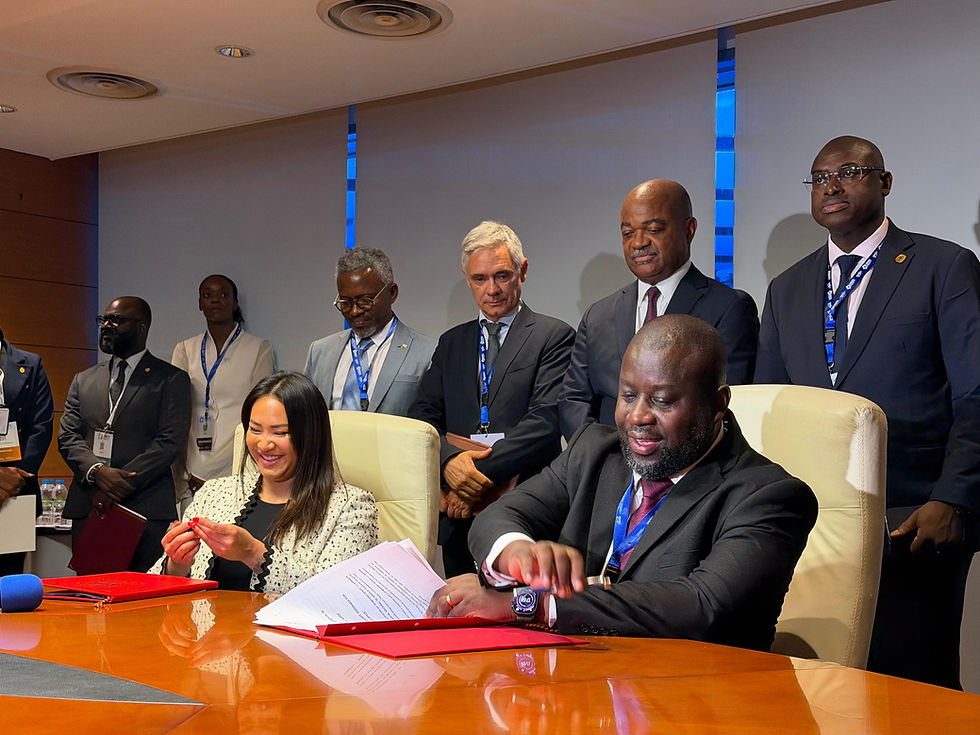
DAKAR, SENEGAL May 19th, 2026 — Symphony Space, a provider of space infrastructure and payload hosting, announced a cooperation agreement with the Agence Sénégalaise d'Études Spatiales (ASES) during the Second Annual Senegal Space Week in Dakar. The agreement, signed with Director General Maram Kaire, establishes a framework for Symphony Space to host Senegalese payloads in orbit and outlines broader avenues for ongoing collaboration.
The ceremony took place under the patronage of the President of Senegal and was attended by more than 400 guests, including government ministers, defense officials, and senior industry leaders. The event drew distinguished representation from across the continent, including the head of the Rwandan Space Agency, underscoring the growing momentum of Africa's space sector on the world stage. Coverage of the event reached regional and international media.
Symphony Space Co-Founder and CEO Merry Walker traveled to Dakar to lead the company's delegation and deliver remarks at the event, addressing the strategic imperative of sovereign space access for emerging space nations.
"Space isn't the new economy. Space is the existing economy — a layer of infrastructure that has quietly become as critical as electricity."
— Merry Walker, Founder & CEO, Symphony Space
Walker emphasized that the decisions nations make today about space infrastructure will define economic and national security trajectories for decades to come.
"The countries that will define the next two decades are the ones with reliable, sovereign, affordable access to operate in orbit. Sovereign access to space is no longer a luxury reserved for the largest economies. It's a baseline requirement for any nation that intends to control its own data, its own security, and its own economic destiny."
— Merry Walker, Founder & CEO, Symphony Space
Africa's Space Economy: The Data Behind the Endeavor
The partnership is grounded in the rapidly expanding scale of Africa's space economy. The sector reached $24.95 billion in 2025 — exceeding earlier 2026 projections by $2.31 billion, two years ahead of schedule — and is on track to reach $39.52 billion by 2030 at a compound annual growth rate of 7.97%.
That growth is inseparable from demographic reality. Africa will account for 85% of the increase in the global working-age population by 2050, with its working-age population nearly doubling to 1.56 billion. By 2030, 40% of the world's young people will be African. For Symphony Space, these figures represent not just market opportunity, but a strategic obligation.

"Our decision to work with partners such as Senegal is because of their ambition and capability to drive the next generation of space innovations across the continent."
— Merry Walker, Founder & CEO, Symphony Space
“Senegal is now present in the great forums of dialogue and cooperation of the global space sector. This international positioning is not an end in itself. Above all, it must serve the concrete development of our country and our continent.”
— Maram Kaire, Director General, ASES
The agreement between Symphony Space and ASES represents a concrete expression of that philosophy, connecting sovereign ambition with the infrastructure required to act on it.
About Symphony Space
Symphony Space is a U.S.-based aerospace startup dedicated to building the foundational infrastructure of the orbital economy. By providing reusable, modular platforms that handle the complexities of space operations, Symphony Space enables commercial, academic, and defense sectors to deploy technology faster and more cost-effectively than ever before.
Symphony Space is unlocking space for all by providing a subscription-based "Space-as-a-Service" model that eliminates the need for costly hardware ownership. Symphony offers simplified, mission-agnostic platforms, allowing both tech and non-tech innovators to launch their missions as easily as deploying a cloud server.


Comments